The Red Urchin Time and Priority Management ecosystem is built on a set of key principles and processes, tried and tested by tens of thousands of users since 2011, to give you the most effective time and priority management system available.
Our complete time and priority management system has two major parts: the underlying principles, rules and processes that are the guiding foundations of the ecosystem, and the Red Urchin application that puts them to work for you.
The Red Urchin application is the critical component at the centre of the ecosystem, but it is the simple principles and processes you follow around it that make it the most effective time and priority management system on the planet.
To understand the Red Urchin ecosystem, we need to start with an overview of what you are looking to achieve. What does success look like when we manage our time well? What do we actually want to achieve, and what do we need in order to get there?
We know from working with our customers that the answer is different for everyone. There are common goals, but people rank them differently.
These are the goals people are typically trying to achieve when they adopt a time management system:
- To complete "everything" they need to get done in a given period (we explain what "everything" means later)
- To stop forgetting important, critical or promised tasks
- To achieve more in the same amount of time
- To use their available time more effectively
- To free up time for the things they normally do not "have time for"
At Red Urchin, we have developed the following as our template for an effective time and priority management system.
Once we know what we are trying to achieve, the diagram below shows the key components we need to get there.
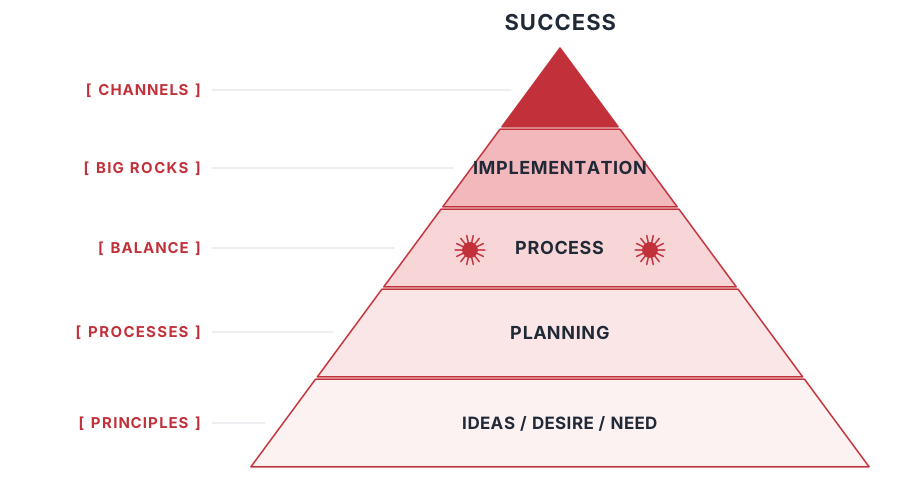
The ecosystem starts with the ideas, needs and desires of what we wish to achieve. These can be anything — a goal, a task, a project, the need to pick up the kids, climb a mountain, or go to a meeting. Without these building blocks there is nothing to plan, nothing to process and no activities to do. But on their own, with no grouping, planning or order, they are just a pile of things to do at some point in time. You have no way of knowing which is the main objective, which are the sub-tasks that deliver it, and which are important, urgent, promised, irrelevant, time-wasting or critical.
So reality (or life) actually looks like the diagram below: a whole lot of stuff coming at us with no rhyme or reason, and us trying to get things done. Without planning or process, tasks conflict with each other and in the end we achieve very little. The noise overwhelms us, we lose focus, distractions abound, and we are drip-fed tasks that may or may not be important, may or may not be urgent, and may or may not be our priority.
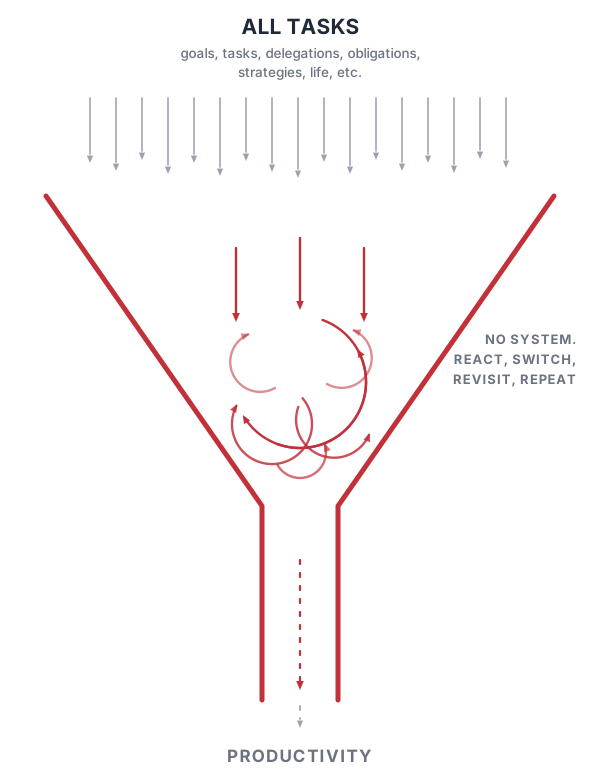
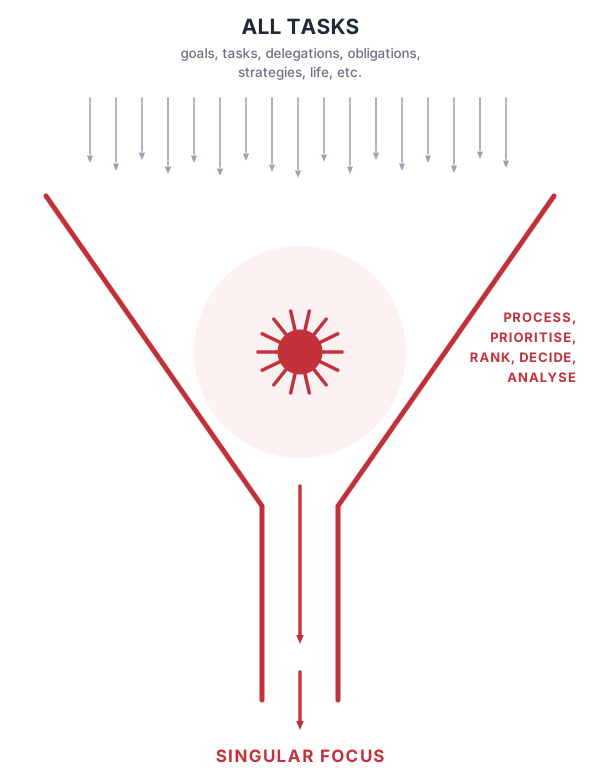
We need to apply planning and process — and then actually implement them — to manage our time and our lives effectively and efficiently.
We need to intervene to ensure our process looks like the diagram below.
The Red Urchin Principles
On what foundation does our planning and process rest? We build on three guiding principles that are paramount to the success of the Red Urchin system — and, in fact, to any successful time management system. We know this from years of trial and error, testing and refinement.
These are:
- KISS (Keep It Simple Stupid)
- Holistic Approach
- Accessible System
Without these three principles, you do not have an effective time management system. Let's explore why they are the foundations we need to build a system that works consistently in the real world.
KISS (Keep It Simple Stupid)
Over the years we have explored many impressive time management systems, on paper and in the digital world, but how they work in theory and how they work in reality are often very different. We know from years of experience, research and testing that if a system or a function is not simple, people will not use it.
Time management is, in large part, about making lots of small decisions based on a few key processes. If the system is too complicated, or not accessible enough (see Principle 3), then users in the middle of a busy day, running between activities, will not make and act on those small decisions — and the process falls apart.
The problem with ALL time management systems is that the moment you stop following the rules — the process, any process — you are back to chaos, or at best a straight-line to-do list (see To-Do Lists vs Red Urchin).
Time management systems need to be simple. We know this, and it has been proven many times. No matter how good a 14-step process looks for mapping tasks on paper, it will not work if people cannot do it quickly and easily, right then and there, before the next demand arrives.
Holistic Approach
The next key principle is that a truly effective time management system must be holistic: it has to accommodate every part of the user's life, not just one slice of it. If we go back to what success looks like, we know that while the details differ from person to person, the key goals of adopting a time management system are the same.
Our goal, as always, is to be a highly effective and balanced individual, and our belief at Red Urchin is that you must plan and balance every facet of your life to get there. There is no point being brilliant at planning your work tasks if you neglect your family and your health in the process. Your system and processes need to cover all of your life.
Accessible System
We know from extensive experience that any system must be easy for the user to reach. Just as a system that is too complex in theory will not work in reality, the same is true of one you cannot get to. Imagine your time management system lived in a book that never left your work desk. What would you do when you were in a meeting and were delegated a task? When someone called and you agreed to have something done by 3pm? When you were at home and decided to pick the kids up after the gym tomorrow? How would you remember any of it, and how would you get it into your system? The simple answer is that you could not — and you certainly could not do it consistently. Your system has to be with you, or close by, all the time for it to be effective (see Writing things down! NOW!).
Writing things down does more than stop you forgetting. It carries a huge mental benefit too: your subconscious knows the task has been dealt with.
On top of our principles, we need some key pillars on which to manage our time and priorities effectively. The foundations are laid; now it is time to look at the Red Urchin pillars.
Red Urchin Pillars
The Red Urchin pillars are built on the principles described above and enabled by the Red Urchin application. There are four key pillars:
- Accessibility — have your system close by, and write things down
- Thinkability — which of the 4 Ds? How long will it take? What do I need to complete it?
- Continuity — learn to pre-populate and use planning cycles
- Responsibility — use the rules of delegation
Accessibility
We covered this in the key principles and in the article Writing things down! NOW! In short: use the Red Urchin application to write things down, every time. Have it with you everywhere — laptop, phone, wherever you are. There is no more important habit in the Red Urchin ecosystem than recording your tasks and the information that goes with them as soon as they arrive (or as close to it as you can manage).
Thinkability
The concept is an easy one, but it takes discipline. Because you have followed the first pillar and your Red Urchin app is close by and accessible, you can ask yourself a few quick questions that apply a first level of filtering to incoming information.
Process the task using the 4 Ds of the Red Urchin system (see The 4D Decision), then ask yourself: what else do I need in order to complete this task when I get to it, and will I be able to find it when I need it? (see Using a Container System).
These quick assessments take only seconds and make an enormous difference to the success of your time management. Once you have processed an incoming task using the 4 Ds, you know when (and whether) you are going to complete it, what you need in order to complete it, and how long it will take. Do this with every incoming task and you have a complete picture to plan with.
Continuity
Time management is not a one-shot effort. It takes continual processing and habit-forming to embed the processes and planning into your daily life and consciousness. That is why continuity matters: once you have worked out how best to tailor the Red Urchin system to you, you must keep applying and improving those processes.
Using key concepts such as pre-population (see A Typical Day) and running effective planning cycles throughout your day (see Cycling through your day) are simple but important skills. They help you apply the Red Urchin system consistently, and that consistency is what makes you a highly effective human.
Responsibility
Responsibility is a lofty goal, and one that managers struggle with in both themselves and the people who report to them. It works hand in hand with the principle of delegation. If you delegate a task, you automatically make that person responsible for it — or do you? Perhaps you are only making them sub-responsible, but that is a matter for another article (see Art of Delegation).
Delegating effectively is a key pillar of the Red Urchin system, and we emphasise the word "effectively". How many times has a manager delegated a task, then wondered in vain, well after the due date, why they have heard nothing? Red Urchin's third D — Delegate — lets you hand tasks off, but how do you do that without suffering the same fate as the manager above? First, set the expectation with everyone you delegate to that they understand the following rules of task delegation:
- Do you understand the task you have been delegated?
- If not, ask questions so that there is no confusion about the task (a lack of clarity is normally the delegator's fault)
- Do you understand the quality expected of the completed task?
- Do you understand the date and time by which the completed task must be returned to the delegator?
- Do you understand that if you cannot meet that date or that standard, it is your responsibility to let the delegator know?
Second, use the "Due from Others" section in Red Urchin. It is one of the most underused functions in any time management system, and it makes a huge difference to your efficiency. Delegating a task effectively does not just get it out of your field of view and off your subconscious — it also means you know exactly when it is due back and to what standard.
We now have the principles and pillars of the Red Urchin system. Next comes taking control of your life using the system alongside the application — but before that, we need to address balance.
Red Urchin Balance
Now that we know the principles and pillars of the Red Urchin system, and what success must look like for highly effective people, we need to look at life as a whole.
We know the system must work in the real world, must be holistic, and must take in all of our tasks, strategies, goals, delegations and obligations. We also need to balance those competing inputs and then process, prioritise, schedule and complete them according to our pillars of effective time management.
Demands on our time come from many sources and, as we have said, any effective time management system must cover all of a user's life. It is critical to include not just work and personal inputs, but time for physical activity, learning, relationships, spiritual life and giving back.
To make sense of this craziness, Red Urchin breaks your world into four key quadrants: first split by need and desire, then by big and small.
Need covers the things we have to do — to earn a living, to meet an obligation, and so on. In a perfect world you would not choose to "send the monthly sales report", but you need to do it, to earn an income, to live. Needs then break into two groups. The first is our activities: daily tasks and sub-tasks. These are the ones we are generally familiar with, the ones that take up most of our time (although perhaps they shouldn't) and make most of the noise in our day.
The second group is the bigger picture around those activities: our overarching strategies and goal objectives. Technically these can fall into both the desire and the need category ("I have a desire to learn photography by the end of the year"), and we treat them slightly differently on the desire side. Our goals and strategic objectives produce sub-tasks that combine to achieve the larger goal. These are normally the larger, bigger-picture items that people find hard to fit in between the bustle of daily tasks. This is exactly why we need a process that manages the daily tasks and noise and keeps us moving towards our strategic goals and objectives.
It is worth noting that need tasks can come from every area of life, not just work (going to the gym may be a need rather than a desire, depending on your point of view). Our need tasks generally consume most of our time and focus, which makes it all the more critical to balance them against our desire tasks. It is this balance that makes us happier and more content people. Remember our definition of success: it is not just about being more efficient, it is also about having (or creating) more time to do the things we enjoy. That is why we must balance need against desire.
Desire: 10s, 25s, 50s and 100s
Desire plays slightly differently in the Red Urchin ecosystem. Desire is driven by exactly that — desire. These are the things we want to do, for a variety of reasons, and we choose to do them. Desire tasks have two components: the tasks themselves and the reasons for doing them. Here we are going to cover the tasks. Red Urchin breaks desire tasks down using the work of Dr Fred Grosse, who first proposed classifying tasks by a person's drivers for happiness, fulfilment and satisfaction. They are very simply:
- 10s
- 25s
- 50s
- 100s
The tasks are grouped by their frequency in your life and their scale, but all are driven by the same outcome — "to make your soul smile". That outcome is the critical driver for these desire tasks. These are the tasks, activities and time that make you smile, that make your heart flutter. You know the feeling: that enveloping calm, that contentment, that warmth of love, that sense of pure achievement. This is what desire tasks are about, and we break them down into different levels.
To explain: a 10 is a type of task or activity you may do at least once a day (or perhaps two or three times a day). A 25 is one you may do once or twice a week. A 50 is something you may do for yourself once or twice a year, an overseas holiday, camping with the kids, going to a show. A 100 is something you do for someone else perhaps once a year or once in a lifetime,
It is a good idea to keep a list of your preferred 10s, 25s, 50s and 100s (this will be included in future versions of Red Urchin). Examples of 10s might be going to the gym (again, for some people this may be a need task), having a quiet coffee, reading a book for 15 minutes, or playing with your kids for 30 minutes. Examples of 25s might be having dinner with a friend, going for a walk on the beach, attending a class, or volunteering at a homeless shelter.
These tasks may be the sub-tasks of a larger strategy or goal that meets the desire criteria. For example, if you have a goal to learn Spanish by the end of the year, then one of your 25s might be to attend a Spanish class twice a week.
These activities are the key to balance in your life, and it is critically important that you schedule them into your planning — otherwise they will not get done. Lock the time in. They matter to you, they are your desires, and they are what make you happy.
Balance! It is the critical component of being a highly successful person. Before you can use the Red Urchin application effectively, you need all of your life inputs coming into it and you need balance between need and desire. We know from a great deal of real-world experience that when you achieve this balance you are not only highly effective, you also get to meet your desires — even if that is just a quiet coffee watching the world go by for 10 minutes a day. And that is a beautiful thing.
In the words of Dr Grosse, it "makes your soul smile" — and that is something we do not do enough.
Putting it all together
Based on everything we have covered, it is now time to put it all together. The Red Urchin application plays a huge role in implementing our time and priority management system, but there are two further strategies that no application can capture for you.
To recap, we have covered:
- What success looks like for highly effective people (The Red Urchin System)
- Why you need a system to be highly effective (The Red Urchin System)
- What a system needs — its principles (The Red Urchin Principles)
- The processes we build the system on (Red Urchin Pillars)
- Ensuring balance exists, and why it is important (Red Urchin Balance)
Now, putting it all together to be highly effective humans, our world looks like this.
There are two key strategies that need to exist in the implementation layer of our time management ecosystem, and these are — drum roll, please —
- Big Rocks
- Channels
Big Rocks
The story behind this implementation strategy has been told many times in many different ways. Here it is as we first heard it, and as we use it in the Red Urchin system.
A Harvard professor (we are not sure why they are always from Harvard, or whether he was really a professor) stands in front of a lecture room full of students. On the table in front of him is an empty square glass fish tank about 1 metre (3 feet) wide. From under the table he lifts buckets full of rocks, each roughly the size of a grapefruit, and fills the tank with them. When he has finished, he asks the class, "Is the tank full?" The students confirm, more or less in unison, that it is.
The professor then takes another bucket from under the table. This one contains gravel, which he tips into the fish tank, filling it all the way to the top. Again he asks the class, "Is the tank full?" With a few laughs, the students agree that it now is. The professor lifts a third bucket from under the table, this time containing sand, and tips that in too. When it is filled to the top he asks, "Is the tank full?" By now the students are more than wary of answering yes.
The professor reaches under the table once more, retrieves a bucket of water and tips it into the tank, filling it to the brim. Smiling, he asks the class, "Is the tank now full?" The students warily reply that it is, and this time the professor agrees. "For all practical purposes, yes, the tank is now full. But what is the moral of the exercise?" After a while, a student answers, "That you can always fit more in?" "That is one of the lessons," the professor replies, "and a key principle of time management. But the greater lesson here is this: if you do not put the big rocks in first, you will never get them in at all."
And there you go — the first implementation strategy. If you track back to balancing your life and your tasks, and to balancing need against desire, the BIG part of both sections was strategies and goals (and the 10s, 25s, 50s and 100s). It translates simply: if you do not put the Big Rocks in first, you will never fit them in. If one of your 50s is to go scuba diving twice a year and you do not book it and lock it in, the noise and small tasks that consume your life will crowd it out. Take a smaller example: if you want to spend 30 minutes of quality time with your kids twice a week, put the big rock in place and build everything else around it, because if you do not put it in first you will never fit it in (sound familiar?). This is what happens to the vast majority of people. Even those who are fairly structured and good at time management forget this one critical implementation strategy.
Channels
This is also a simple concept, and one we could (and maybe will, in the future) dedicate multiple articles to. The principle is to achieve singular focus at all points in time. It sounds strange, but it drives two very important outcomes. First, it ensures you focus on and complete your designated task in the shortest possible time. Second, it ensures you are 100% present, in the moment. These two outcomes are different sides of the same coin, and it is the type of task that dictates which side you land on.
The principle comes from the idea of a remote control: you switch channels when you need to, just as you would on a TV, and you watch one channel at a time. It breaks down into two distinct working levels, both essential to the Red Urchin system and to the effective implementation of our time management principles.
From a high-level view, the channel principle is about being in the moment, and in the environment you are meant to be in. Say channel 2 is your work channel (the numbers are irrelevant), channel 8 is your home channel and channel 10 is your kids' channel. Between 6pm and 8pm you may be on channel 8, and for those two hours you are 100% dedicated to it. That means not slipping across to channel 2 to check email or take a phone call. Similarly, if 1pm to 2pm is your allocated time to complete a work task, you do not stop to talk to a co-worker about the weekend, and you do not let anyone interrupt you or switch your channel for you. So when you are at work you switch to channel 2, and you keep the weekend chat to a minimum. On channel 8 you switch off your phone and check it only at scheduled intervals. On channel 10, nothing disturbs your time: you are not thinking about anything else, because you have written everything down, and you are completely in the moment.
This achieves two very important goals: the first a life and balance goal, the second an efficiency goal. The life and balance goal is about being present in the moment. There is nothing worse, for you or for the people you are with, than not being 100% present. It takes practice and diligence over time to become proficient, but we know from experience that it is a critical piece of the balancing puzzle. Switch off your phone, your social media and the TV, be ruthless in applying this, and be present. It does not matter whether you are in a class learning or having dinner with a loved one — be there.
The second goal is simply ruthless efficiency, and it is particularly relevant to office and group environments. If you are at work, be at work and get your work tasks done. If you are reading, read. The office is where this is hardest: studies have shown over and over again how much time is lost there to unproductive activity. Look at the habits of highly effective, high-performing individuals (and we have) and a key behavioural trait is that they focus completely on the environment they are in. This means cutting short unfocused activities, closing your office door (or putting up a Do Not Disturb sign), and skipping the office birthday celebration. We know this has an impact on networking and social acceptance, but our goal here is effective time management rather than making more friends, so it is up to you to find the balance that works for you.
Our second, lower-level implementation of this strategy is reducing distractions. The single most important reason people do not achieve what they set out to achieve, even when they have planned and prioritised brilliantly, is distraction. Distractions cost you not only the time of the interruption itself, but also the time it takes to refocus and catch up to where you were on the task. Sometimes that is seconds; other times it is precious minutes. At this level, the concept of channels simply means focusing on what you need to do, for as long as you can, until it is completed. That means not constantly checking (or being alerted to) email, not answering your phone, and not being disturbed by whoever wanders past. This is difficult to achieve completely, but you can do it. Take small steps, ask the people close to you to remind you when you are crossing channels, reduce your distractions, and focus on what you need to be focused on.
These implementation strategies are critical to getting the most from the Red Urchin application. Follow the steps in the Red Urchin guides, built on the principles and strategies of the Red Urchin system, and you will achieve the success we outlined at the start. You will:
- Complete "everything" you need to get done in a given period
- Stop forgetting important, critical or promised tasks
- Achieve more in the same amount of time
- Use your available time more effectively
- Achieve the things you normally do not "have time for"
And you will do all of it with incredible balance and a real sense of achievement.